Real-time signal orchestration — your tools saw the same attacker. None of them compared notes.
Pillar 9 of 25 · 7 min read · Grounded in l hybrid identity architecture research — IBM, NVIDIA, HYPR & Ciptor
See how this applies to your environment
Book a 30-minute briefing with Ciptor. We'll walk through what live-fire validation typically uncovers in environments like yours.
The assumption
Each security tool fires alerts when it detects a threat. The SOC reviews those alerts and identifies patterns. That is how attacks are detected.
Enterprise security programmes are built on the premise that best-in-class tools, properly deployed, will surface threats for SOC analysts to act on. Identity provider, EDR, SIEM, network monitoring — each tool monitors its domain, generates alerts when something anomalous occurs, and routes those alerts to the SOC queue. Analysts review the queue, identify the patterns that indicate a real attack, and respond. The more mature the tool deployment, the better the detection. The logic seems sound.
1The reality
Your tools generate signals in isolation. An impossible-travel alert and a lateral movement alert firing ten minutes apart are almost certainly the same attack. Nothing in your stack correlates them automatically in real time.
Enterprise security stacks are built by accumulation — an identity provider here, an EDR vendor there, a SIEM from a third, network monitoring from a fourth. Each tool is best-in-class for its domain. None were designed to share a common signal taxonomy, a shared entity model, or a real-time event correlation layer with each other. The result: enormous volumes of individually correct but contextually isolated signals.
45%
Of SOC analysts report that alert fatigue causes them to ignore or deprioritise alerts they know may be significant — because the volume makes it impossible to investigate every signal before the next wave arrives.
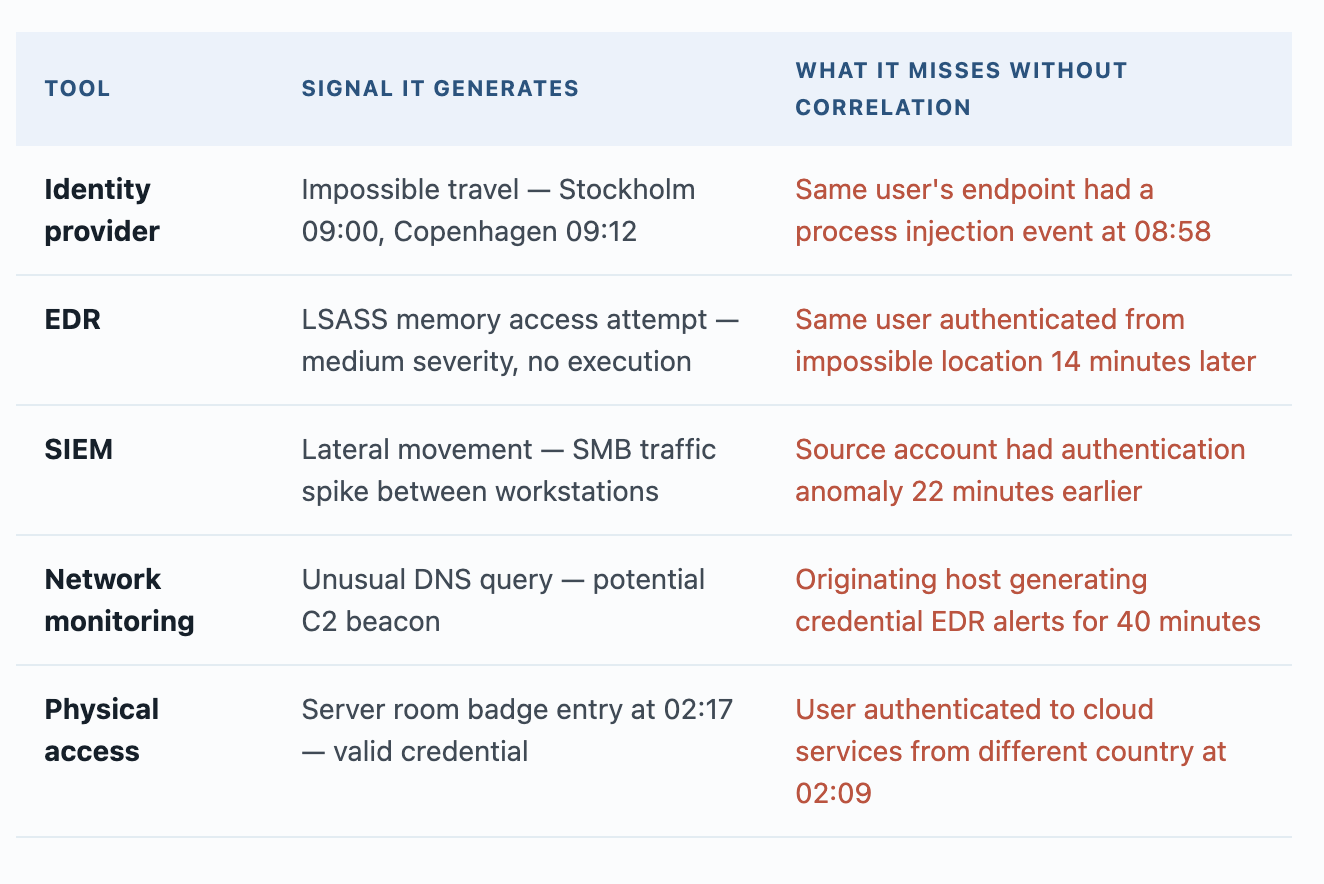
The multi-stage attack generates signals across four tools in four consoles. Each signal individually looks like a medium-severity alert. Correlated together, they are a critical incident in progress. Without real-time correlation, the analyst sees four medium alerts. The attacker sees a clear path.
19 Days
Median attacker dwell time in environments with mature individual tool deployments but no cross-tool correlation layer. In environments with real-time signal orchestration, dwell time drops to under 5 days. The tools are working. The integration layer is the gap.
The Blueprint
Build a shared entity model, deploy real-time cross-tool correlation, and feed physical access into the same signal layer — starting with the hardware credential that creates one identity anchor across every system.
The solution is not more tools. It is a shared identity anchor that every existing tool can resolve to the same person, combined with a correlation layer that applies logic to the signals already being generated but not connected.
The signal isolation problem in detail
A user authentication event in Azure AD has no awareness of an endpoint process injection event in CrowdStrike that occurred for the same user 8 minutes earlier. A network anomaly in Darktrace has no link to the impossible-travel alert in Okta that preceded it. Each tool fires correctly. No tool fires with full context. The attacker understands this architecture — the multi-stage attack is specifically designed to stay below the single-tool detection threshold across every phase.
"We don't have a detection gap because we lack alerts. We have a detection gap because the alerts we get for multi-stage attacks look like unrelated medium-severity events in isolation. The correlation that would make them critical doesn't exist in real time."
SOC operations synthesis, Ciptor adversarial validation 2025
The signal gap — what each tool sees and what it misses
Why the entity model is the root problem
Before correlation rules can work, every tool must refer to the same user using the same identifier. In most enterprise environments this does not happen. The identity provider uses a UPN (user@company.com). The EDR uses a SAM account name (DOMAIN\jsmith). The SIEM ingests both plus an IP address. The network monitoring tool knows a MAC address. Physical access control knows a badge number.
No correlation engine can reliably join these signals in real time without a matching layer — and every matching layer introduces latency and error rates that degrade alert quality. The root problem is that each tool is anchored to a different representation of the same identity.
A hardware security key solves this at the credential layer. The same physical token authenticates the user to cloud SSO, Windows domain login, VPN, and physical access control. Every authentication event across every system carries the same cryptographic identifier derived from the same hardware credential. The correlation engine resolves john.smith@company.com in Azure AD, DOMAIN\JSMITH in Active Directory, and badge 4471 in physical access to the same hardware token — not by guessing, but because all three authentication events were signed by the same key.
Three layers of signal orchestration
1. Shared entity model — one credential, one identifier.
Deploy hardware security keys that support both FIDO2 and PIV. Every authentication event — cloud, on-premises, VPN, physical access — carries the same cryptographic identifier derived from the same physical token. This is not a configuration change in your SIEM. It is an architectural change at the identity layer that makes every subsequent correlation rule more reliable, faster, and less prone to false positives caused by mismatched identifiers.
2. Real-time cross-tool correlation — SOAR or XDR
Deploy a SOAR layer or modern XDR platform that ingests signals from all tools in real time and applies correlation rules across them. The specific rule that catches the scenario above: any combination of identity anomaly + endpoint signal + network anomaly for the same entity within a 30-minute window escalates automatically to critical and pages an analyst — regardless of individual alert severity. This is not AI detection. It is logic applied to signals your tools already generate but do not connect. Most XDR platforms can implement this rule in under an hour once the shared entity model is in place.
3. Physical/logical convergence — feed the badge log into the SIEM
Connect your physical access control system to your SIEM as a real-time data source — not a weekly report. Most modern access control systems (Lenel, Genetec, Software House, Honeywell Pro-Watch) have syslog or API output. Once the physical feed is live, the correlation rule for impossible geographic presence — badge entry in Stockholm at 02:17, cloud auth from a different country at 02:09 — catches a stolen badge automatically. This is the gap Volume 10 covers in full.
NeoWave & Feitian — the security keys that create the entity anchor
The shared entity model is the foundation that makes signal orchestration work. Both NeoWave and Feitian BioPass K49 provide FIDO2 and PIV support — meaning one physical token covers cloud SSO, Windows domain, VPN, and physical access control integration in a single cryptographic identity anchor
Hardware keys — the identity anchor your correlation engine needs
NeoWave — ANSSI-certified, CC EAL6+, FIDO2 + PIV, EU sovereign supply chain
French-engineered and ANSSI Security Visa certified. CC EAL6+ secure element. FIDO2 for cloud SSO and modern authentication, PIV for Windows domain, VPN, and physical access control integration. One token across every system means one cryptographic identifier across every signal — the entity anchor your SOAR or XDR platform needs to correlate without a lossy matching layer. The ANSSI sovereign supply chain certification makes it the right choice for regulated industries, defence, and critical infrastructure where the manufacturer's national jurisdiction is a board-level procurement consideration under NIS2 Article 21.
The NIS2 compliance case: Article 21 phishing-resistant MFA + ANSSI certification = the most defensible authentication posture for an EU essential entity. One document answers both the MFA requirement and the supply chain question.
Feitian BioPass K49 — CC EAL6+, on-device fingerprint, FIDO2 + PIV, PQC-ready
CC EAL6+ secure element with on-device fingerprint verification — the template never leaves the chip, authentication is user-bound not device-bound. FIDO2 and PIV support delivers the same unified identity anchor across cloud, on-premises, and physical access. PIN-sharing and token-handover are eliminated at the biometric layer — meaning the entity identifier is not just hardware-bound but person-bound, removing the residual risk that undermines shared workstation deployments. PQC-ready via dedicated ML-KEM/ML-DSA hardware co-processor, satisfying DORA's long-term digital resilience mandate and the EU COM(2026) 13 PQC transition timeline.
The workforce compliance case: NIS2 Article 21 + DORA Article 9 + ISO 27001 A.8.5 + SOC 2 CC6.1 = complete compliance coverage at scale, with biometric proof of user identity at every authentication event across every system in your stack.
What changes when the entity model is in place
When one hardware token provides the cryptographic identifier across every system, cross-tool correlation becomes fast, accurate, and actionable. The impossible-travel alert in the IdP and the LSASS dump alert in the EDR resolve to the same entity in under a second — because both events carry the same key identifier, not because a matching algorithm guessed. The SOAR escalation rule fires. An analyst gets a single critical alert with full context: authentication anomaly, endpoint signal, credential access attempt, same user, same 15-minute window.
That is the difference between 19 days of dwell time and under 5. Not more tools. Not more analysts. One entity anchor and one correlation rule applied to signals the stack was already generating.
Next — Vol. 10 Convergence of physical and logical access
Someone badged into your server room at 02:17. Your SOC monitors the IT stack. The physical access log lives in a separate system reviewed weekly. The attacker had the whole weekend.
