Physical & logical access convergence — the badge entry your SOC will never see
Pillar 9 of 25 · 7 min read · Grounded in l hybrid identity architecture research — IBM, NVIDIA, HYPR & Ciptor
See how this applies to your environment
Book a 30-minute briefing with Ciptor. We'll walk through what live-fire validation typically uncovers in environments like yours.
The assumption
Physical security is a facilities management function. IT security handles logical access. The two disciplines operate independently and use different systems.
In most enterprise organisations, physical security and IT security sit in different parts of the organisation chart, report to different executives, use different vendor platforms, and operate entirely separate monitoring stacks. The building access control system is procured by facilities, maintained by a different team, and reviewed via a weekly badge report that no one in the SOC reads in real time. IT security monitors authentication logs, endpoint events, and network traffic. The assumption: each discipline secures its own domain and the two do not need to intersect in operational monitoring.
The reality
The most sophisticated attacks increasingly combine physical and logical access. A valid badge entry and a cloud authentication event from a different country at the same timestamp is a critical incident — but only if the two systems share a signal.
The physical/logical boundary is one of the most deliberately exploited gaps in enterprise security. An attacker with a cloned badge and a stolen credential can operate in the physical and digital environment simultaneously, generating events in two completely separate systems that individually appear legitimate. Neither system alone has enough context to classify what is happening. Combined, the pattern is unambiguous.
34%
Of security breaches involve an insider threat component — a malicious insider, a compromised credential used for physical access, or a social engineering attack that required physical presence. None are detectable from IT security tools alone.
64%
Of organisations have no integration between their physical access control system and their IT security monitoring stack. Physical access events are invisible to the SOC unless an analyst manually reviews a separate badge report — typically weekly, not in real time.
The blueprint
Feed physical access events into the SIEM in real time, build cross-domain correlation rules for the four highest-risk scenarios, and unify deprovisioning across physical and logical access in a single automated workflow.
Physical/logical convergence does not require replacing your access control system. It requires connecting its log output to the correlation layer that already monitors your IT environment — and then applying logic to the combined signals that neither system could apply independently.
Four attack scenarios your current stack cannot detect
Each scenario below is a documented attack pattern. Each generates signals in at least two separate systems. Neither system alone classifies it as a security event. Combined, each is a critical incident in progress.
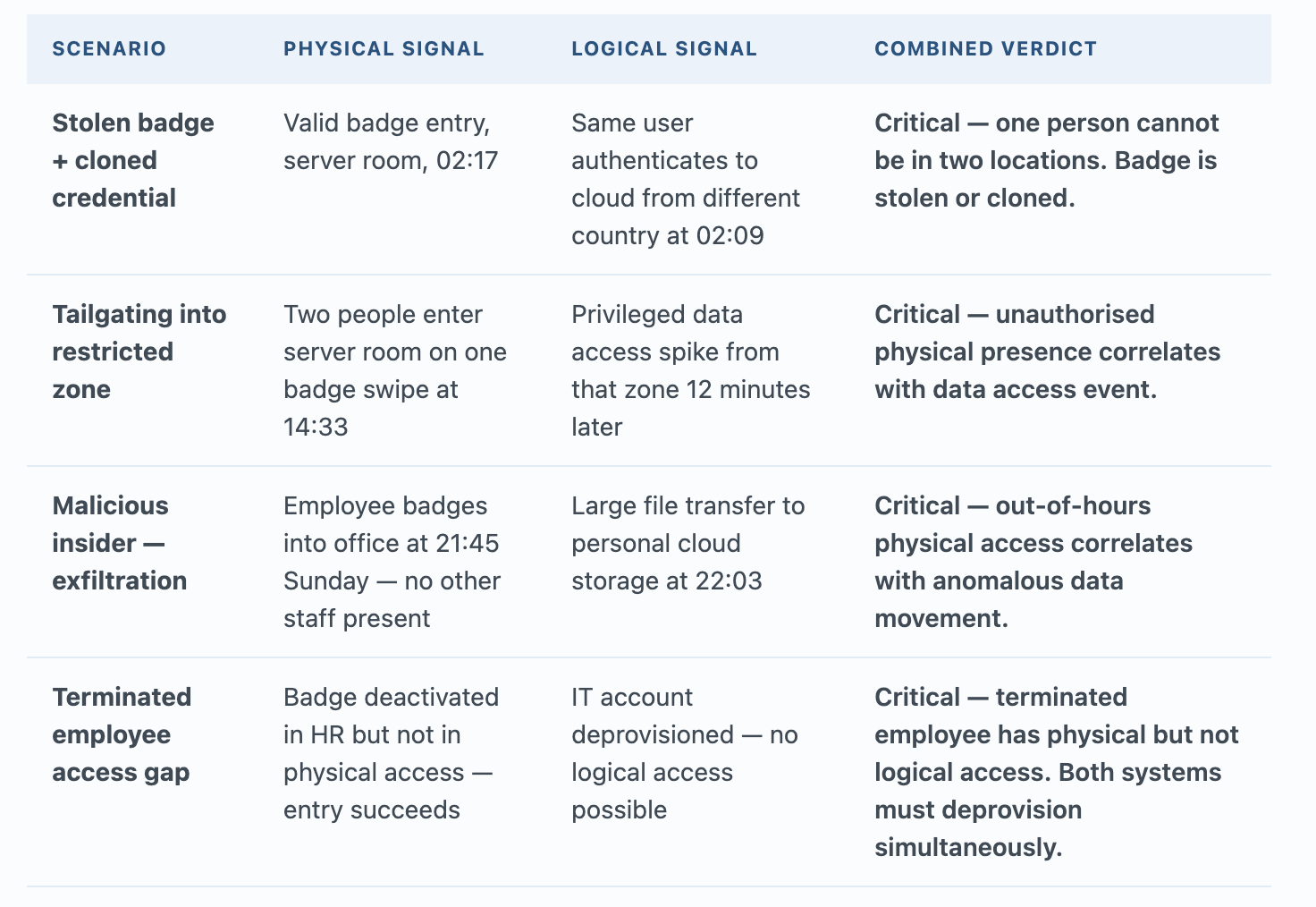
Why deprovisioning is the most common physical/logical gap
The terminated employee scenario is the highest-frequency physical/logical failure in the breach data — not because organisations forget to deprovision, but because IT and physical access deprovisioning are separate manual processes triggered by separate tickets processed by separate teams. The IT account is deprovisioned the day the employee leaves because it is on the security team's standard offboarding checklist. The badge is deprovisioned three days later when the facilities ticket is processed.
Those three days represent a window during which a disgruntled former employee, or anyone who took their badge, can access your physical premises with a valid credential. Without IT access, they cannot reach your systems directly. But they can access server rooms, network equipment, and the physical infrastructure that underpins every digital control you have deployed.
Three steps to physical/logical convergence
1. Feed physical access events into your SIEM in real time
Most modern access control systems — Lenel, Genetec, Software House, Honeywell Pro-Watch — have syslog or REST API output. Connect the physical access log as a SIEM data source rather than a weekly report. This is the minimum viable integration. It requires no change to the physical access system itself and no procurement of new infrastructure. Once the feed is live, your existing correlation rules can reference physical events alongside logical ones. The impossible geographic presence rule — badge entry in one city, cloud auth in another at the same timestamp — can be written in under an hour.
2. Build cross-domain correlation rules for the four scenarios
Impossible geographic presence, tailgating + data access, out-of-hours badge + file transfer, deprovisioning gap. Each can be expressed as a SIEM correlation rule using standard logic. These are not edge cases — they are the four most common physical/logical attack patterns in the breach data. Building rules for them is not advanced threat hunting; it is catching the obvious. Prioritise the deprovisioning gap first: it is the highest-frequency scenario and the easiest to build a rule for because the HR termination event is already a structured data point in most environments.
3. Unify deprovisioning in a single automated lifecycle workflow
When an employee leaves, both IT account and physical access credential must be deactivated in the same automated workflow — triggered by the same HR system event, executed simultaneously, with no manual ticket in the critical path. The implementation pattern: HR system emits a termination event → identity provider deprovisioning fires → the same event payload is routed to the physical access control system API to revoke the badge. Same trigger, same timestamp, no gap. A leaver who retains physical access for three days after IT deprovisioning is an insider threat risk for exactly those three days. This workflow eliminates the window entirely.
Identity is the thread that runs through every regulation — and hardware keys make compliance provable
Over ten volumes, ten attack vectors, and two full pillars, the same foundation has appeared at the solution to every problem we have examined. The ability to prove — in real time and retrospectively — that the right person accessed the right resource at the right time using a credential that could not have been intercepted, replayed, or impersonated.
This is not an abstract security principle. It is the core evidentiary requirement of every regulatory framework that governs your organisation. The question regulators ask in an audit is always a version of the same thing: can you prove who accessed what, when, using a credential that could not have been compromised?
Password-based MFA cannot answer that question. A phishable credential cannot answer it. A hardware security key — anchored in asymmetric cryptography, physically bound to a certified chip, generating an unforgeable audit trail at every authentication event — is the only control that can. And for physical/logical convergence specifically, only a key that supports both FIDO2 and PIV creates the unified identity anchor that closes the gap at the credential layer rather than the correlation layer.
Regulatory compliance — what hardware keys prove and what they cannot
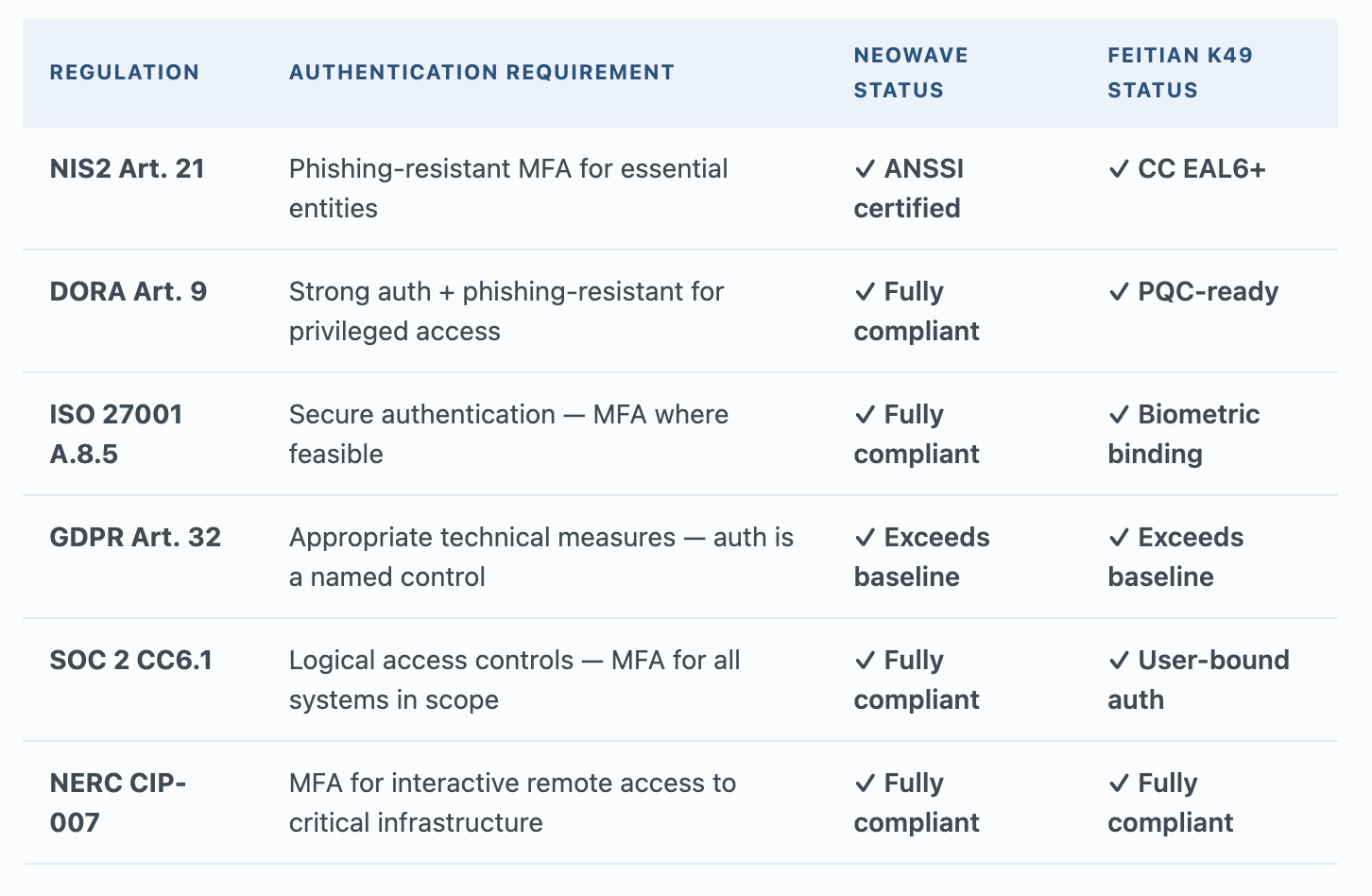
NeoWave & Feitian — hardware keys that make compliance provable, not just claimable
NeoWave — the compliance anchor for regulated and sovereign environments
French-engineered and ANSSI Security Visa certified — the only EU-sovereign hardware authentication standard that formally validates the supply chain, not just the protocol. CC EAL6+ secure element. FIDO2 for cloud SSO and modern authentication, PIV for Windows domain, VPN, and physical access control integration. One token means one cryptographic identifier across logical and physical access — the entity anchor that makes impossible geographic presence detection reliable without a lossy identifier-matching layer. When your auditor asks for evidence of phishing-resistant MFA and evidence that your authentication hardware supply chain is free from adversarial jurisdiction exposure, NeoWave answers both questions with a single document: the ANSSI Security Visa certificate. For regulated industries, defence supply chains, and critical infrastructure where the board resolution approving your NIS2 Article 21 controls needs to cover sovereign supply chain assurance — NeoWave is the only key that delivers all three simultaneously.
NIS2 compliance case: Article 20 board approval + Article 21 phishing-resistant MFA + ANSSI certification + PIV for physical access integration = the most complete and defensible authentication posture available to an EU essential entity operating across both logical and physical domains.
Feitian BioPass K49 — the compliance anchor for workforce-scale deployment
CC EAL6+ secure element — the highest assurance level in production authentication hardware. On-device fingerprint verification: the template never leaves the chip, authentication is user-bound not device-bound. FIDO2 and PIV support provides the same unified identity anchor across cloud, on-premises, and physical access control — closing the physical/logical convergence gap at the credential layer. Biometric binding eliminates PIN-sharing and token-handover as residual risks, meaning the SOC 2 and ISO 27001 question about whether a shared workstation with a plugged-in key constitutes compliant user authentication has a definitive answer: yes, because the fingerprint proves which user activated the key. PQC-ready via dedicated ML-KEM/ML-DSA hardware co-processor, satisfying DORA's long-term digital resilience mandate and the EU COM(2026) 13 post-quantum transition timeline. The biometric architecture also provides future-proof compliance for emerging EU AI Act authentication provisions that distinguish between device possession and user identity proof.
Workforce compliance case: NIS2 Art. 21 + DORA Art. 9 + ISO 27001 A.8.5 + SOC 2 CC6.1 + NERC CIP-007 + PQC-readiness = the most complete cross-regulatory compliance coverage available at scale, with biometric proof of user identity at every authentication event across every system — logical and physical.
What ten weeks of Zero Assumptions has built toward
Weeks 1–5 (Pillar 1 — Adversary tactics): EDR blind spots, AiTM session bypass, deepfake helpdesk attacks, hardware supply chain risk, hybrid Kerberos blindspots. Every attack vector targeted the credential layer — the fix in every case was a hardware credential that eliminated the attack surface.
Week 6 — Risk assessment integration: Annual assessments capture a snapshot. Identity drift — excess entitlements, undeprovisioned accounts — accumulates silently between cycles. Continuous monitoring catches what periodic tests miss.
Week 7 — Session token vulnerability: Authentication is an event. The session that follows is a window. 207 days to detect, 50% of incidents at the weekend. CAE and device-bound tokens close the window before the attacker can use it.
Week 8 — Boardroom accountability: NIS2 Article 20 puts personal liability on management bodies. Five documents every CISO must deliver to the board before enforcement arrives.
Week 9 — Signal orchestration: Two tools, same attacker, ten minutes apart, no correlation. The shared entity model — one hardware credential across every system — fixes the root problem that no SOAR rule can solve without it.
Week 10 — Physical/logical convergence: The badge entry your SOC never saw. Feed the physical log into the SIEM, build the four correlation rules, unify deprovisioning. The final gap in the operational stack is closed.
Every assumption across ten volumes had the same fix at its foundation: a hardware credential that proves identity — not just device possession, not just knowledge of a password, but cryptographic proof that the right person authenticated from the right device. The regulations have caught up with the attackers. The question for every CISO reading this series is whether their authentication stack has too.
Next — Hardware root of trust Vol. 11 — The chip is the control
Everything in Vol 1-10 assumes a trustworthy hardware credential at the base of the stack. Vol. 11 asks what "trustworthy" actually means at the chip level — and why the answer determines whether every other control is standing on solid ground.
