Your vendor passed the audit.
Their contractor didn't.
Pillar 12 of 25 · 6 min read · The breach didn't come through your door. It came through someone else's key. Why supply chain identity is the most exploited vector in your environment — and what NIS2 Article 21 now requires you to do about it.
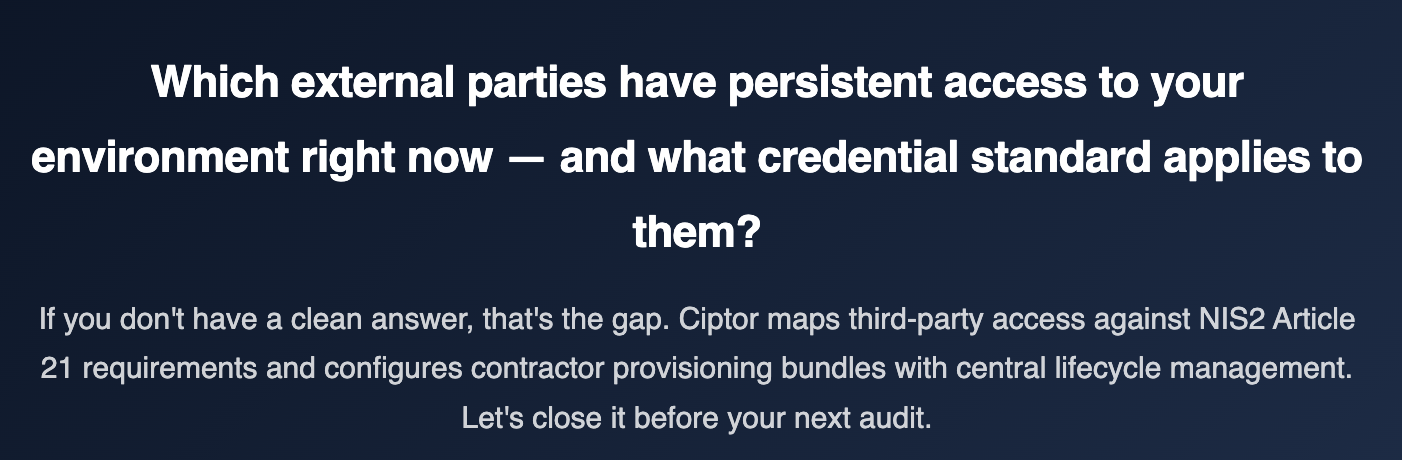
See how this applies to your environment
Book a 30-minute briefing with Ciptor. We'll walk through what live-fire validation typically uncovers in environments like yours.
Hardware Root of Trust — Volumes 11–15
Vol. 11 established why CC EAL6+ certification matters at the chip level. Vol. 12 asks the next question: what good is a hardened chip inside your perimeter if the credentials touching your environment from outside it have never been held to any hardware standard at all? Supply chain identity is where your security policy ends and the attacker's opportunity begins.
The Assumption
If our internal identities are secured with phishing-resistant hardware authentication, our external business systems are protected. We've done the hard work internally — the perimeter holds.
The Reality
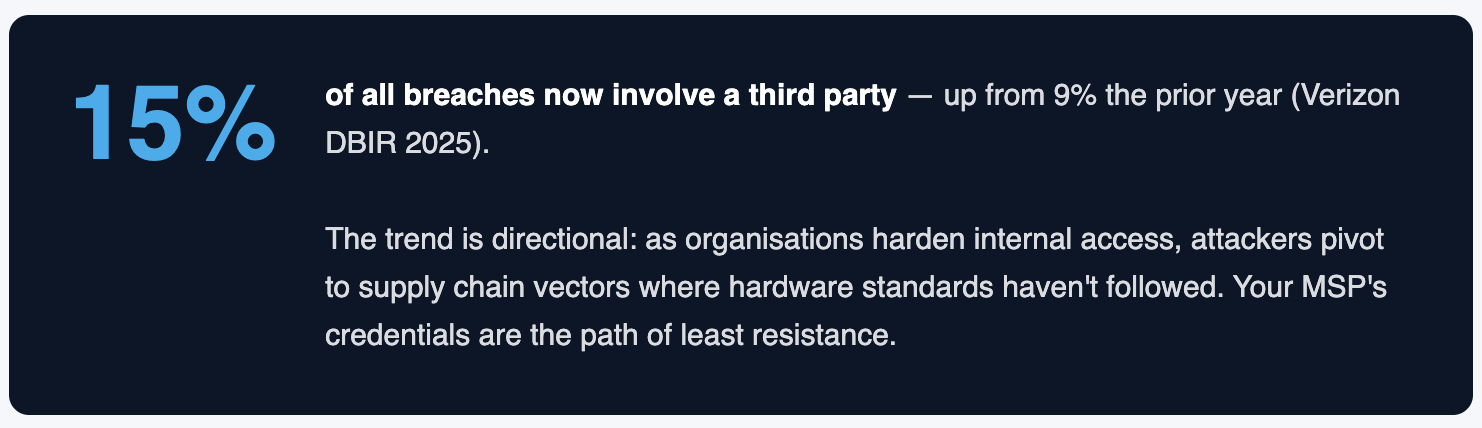
According to the 2025 Verizon Data Breach Investigations Report, 15% of all breaches now involve a third party — up from 9% the prior year. NIS2 Article 21 places explicit supply chain risk management obligations on essential and important entities precisely because threat actors know the perimeter is strongest where you're looking, and weakest where you're not.
The Blueprint
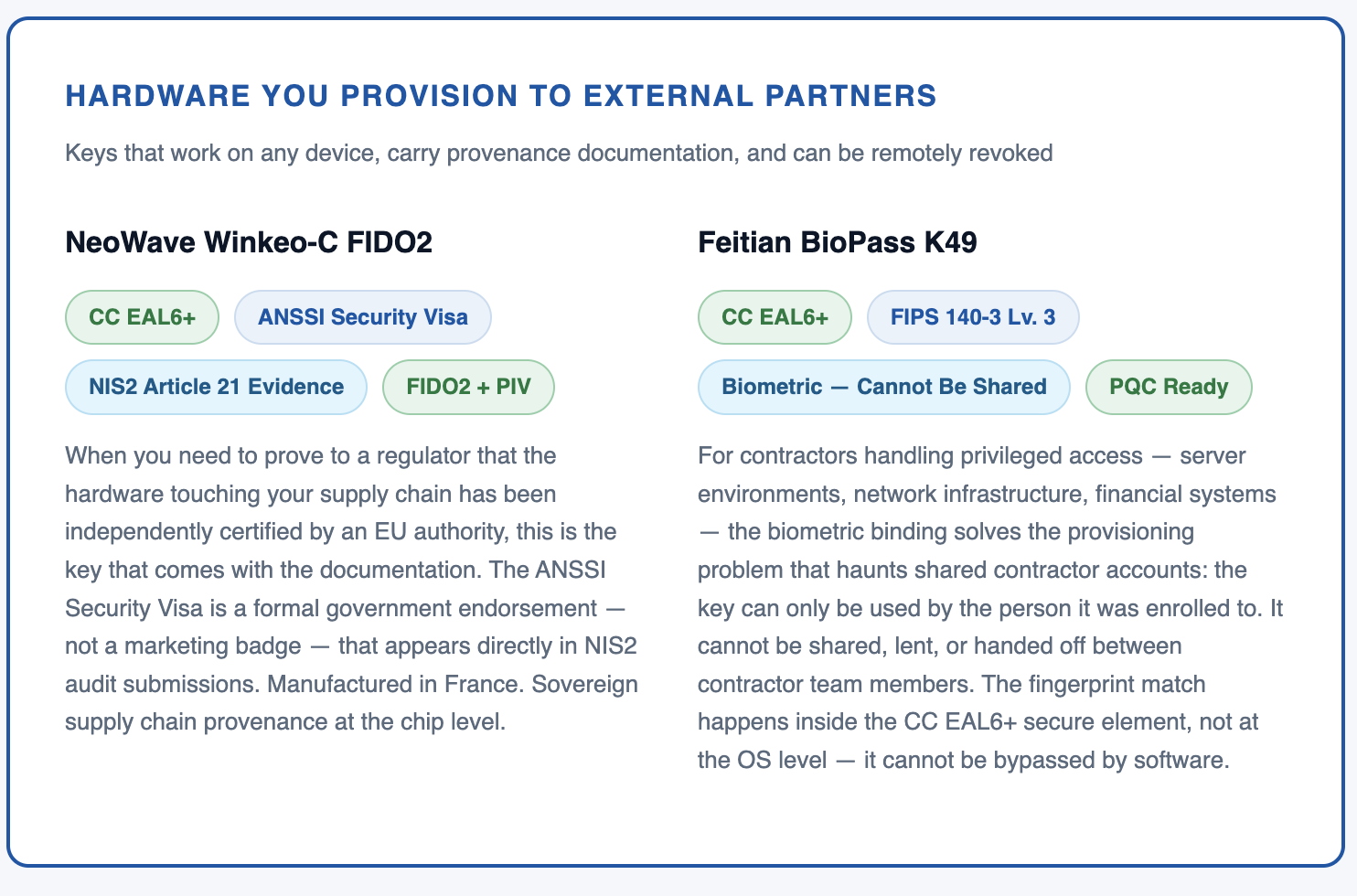
Enforce the same phishing-resistant hardware standard across all external parties with persistent, privileged, or unmonitored access to your environment. Provision the key — don't request it. Include supply chain authentication controls in your NIS2 Article 21 audit evidence.
The Door You Left Open
One in three security incidents doesn't start with a phishing email sent to your employees. It starts with a valid login — from a trusted third party whose credentials were never held to the same standard as your own. A supplier. An IT contractor. A managed service provider connecting to your environment every Tuesday morning to run patching cycles.
They passed your vendor assessment. They signed your security policy. And their access was provisioned with a password and an SMS code — because requiring a hardware key felt like too much friction for an external partner.
That friction calculus is the assumption worth challenging. The question isn't whether it's convenient to require hardware keys from external parties. The question is whether you can accept that your identity security posture is only as strong as the weakest credential touching your systems.
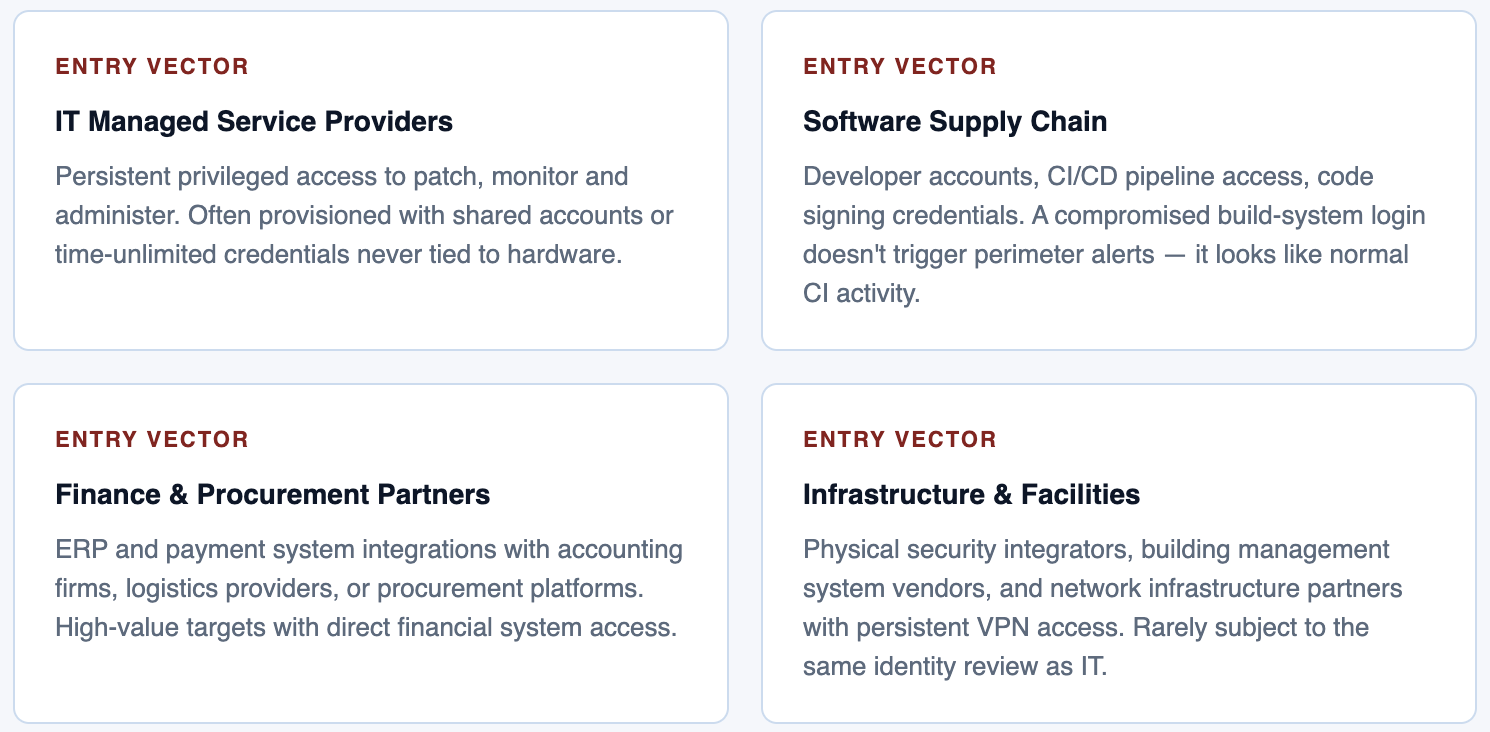
Where Third-Party Access Gets Exploited
The attack surface isn't abstract. These are the four entry points where credential standards consistently diverge between internal users and external parties — and where breaches consistently originate.
The Blueprint in Practice
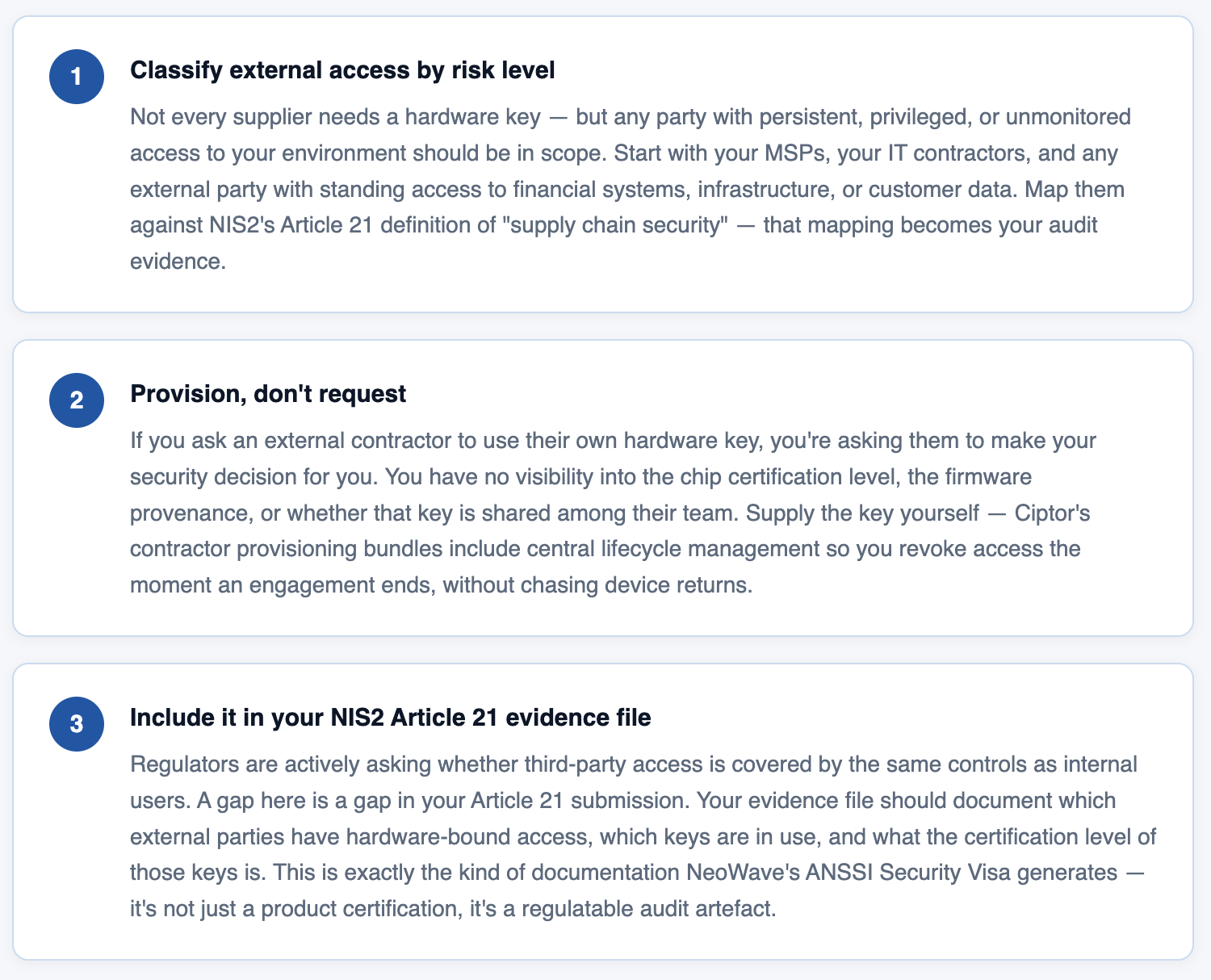
Bringing third-party access into scope for hardware key requirements doesn't require rebuilding your identity architecture. It requires three operational decisions.
NIS2 Article 21: What Supply Chain Actually Means
Article 21(2)(d) of the NIS2 Directive requires essential and important entities to implement "supply chain security, including security-related aspects concerning the relationships between each entity and its direct suppliers or service providers." This isn't limited to software supply chain. It covers any supplier relationship that touches your security posture — including the managed service provider running your patching cycles and the IT contractor with standing VPN access.
The practical question regulators will ask: what is the authentication standard applied to external parties with persistent access to in-scope systems? "Password plus SMS" is not a defensible answer under NIS2 enforcement that began in October 2024 across EU member states.