Session Token Vulnerability - continusous authentication vs. static sessions
Pillar 1 of 25 · 7 min read · Grounded in l hybrid identity architecture research — IBM, NVIDIA, HYPR & Ciptor
See how this applies to your environment
Book a 30-minute briefing with Ciptor. We'll walk through what live-fire validation typically uncovers in environments like yours.
The Assumption
Strong authentication at login means the session that follows is trustworthy for its duration.
Modern identity programmes invest heavily in making the login event resistant to attack. FIDO2 hardware keys eliminate phishable credentials. Conditional access policies enforce device compliance at authentication time. MFA adds a second factor. Once the user has passed all of these controls and received a session token, the assumption is that the session is secure — the authentication already happened, the identity was verified, and the application should trust the resulting session until it expires or the user logs out.
The Reality
Session tokens are one of the most actively targeted artefacts in enterprise environments. Once stolen, they bypass every authentication control you have deployed — because authentication already happened.
The attack has moved downstream from the login event. Session hijacking targets the token issued after authentication succeeds, not the authentication itself. An attacker who obtains a valid session token can replay it against the same application without re-authenticating. From the application's perspective, every subsequent request is indistinguishable from a legitimate user action — because it carries a valid, recently-issued token from a genuine authentication event.
207 Days
The average time for an organisation to identify a breach. Nearly seven months during which an attacker operating on a stolen session has unrestricted access to every resource the legitimate user could reach, generating authentication events that look entirely normal.
Source: IBM Cost of a Data Breach Report
The three primary token acquisition techniques in active use: malware-based cookie theft from browser storage, AiTM (Adversary-in-the-Middle) proxy attacks that intercept the token in transit after authentication completes, and post-compromise token extraction from memory or credential stores on a compromised endpoint. All three have industrialised toolkits available at commodity prices. None of them require the attacker to bypass your FIDO2 hardware key — because they operate after authentication is complete.
50%
Of ransomware and major security incidents are initiated at the weekend — when SOC staffing is reduced, alert triage is slower, and the time from initial access to first human review is measured in hours rather than minutes. Attackers plan around your on-call rota.
The combination is the real exposure: a stolen session token that generates no unusual authentication signals, acquired on a Friday afternoon, replayed through a weekend when your SOC is running at reduced capacity. By Monday morning the attacker has had 60+ hours of undetected access — and the Monday alert queue is too deep to triage the anomaly before lateral movement is complete.
The Blueprint
Move from static session tokens to architecturally constrained sessions — short-lived, device-bound, and subject to real-time policy revocation regardless of when or where the attacker operates.
The answer is not more SOC analysts on the weekend rota. It is architectural controls that make the session itself a smaller, shorter-lived target — one that yields nothing useful by Monday morning even if it was stolen Friday afternoon.
The SOC response time problem in detail
The 207-day average detection time is not a technology failure — it is a signal-to-noise problem. A stolen session token generates authentication events that are structurally identical to legitimate ones: correct user identity, valid token, normal application access pattern. There is no failed authentication, no unusual credential, no malware signature. The only signal is behavioural — and behavioural anomaly detection requires a baseline, context, and time to establish both.
Alert volume alone does not produce faster detection. A SOC processing 10,000 alerts per day with a 40% false positive rate and no session-level behavioural context will not find a stolen session even if an alert fires — because the alert will be one of several thousand that day, with no enrichment that distinguishes it from a legitimate user accessing the same resource from a new location.
We don't have a detection gap because we lack alerts. We have a detection gap because the alerts we get for session-based attacks look identical to normal user behaviour. The attacker doesn't trigger anything anomalous — they just use the session."
— SOC operations synthesis, adversarial validation 2026
The attacker's timeline — what happens in each window
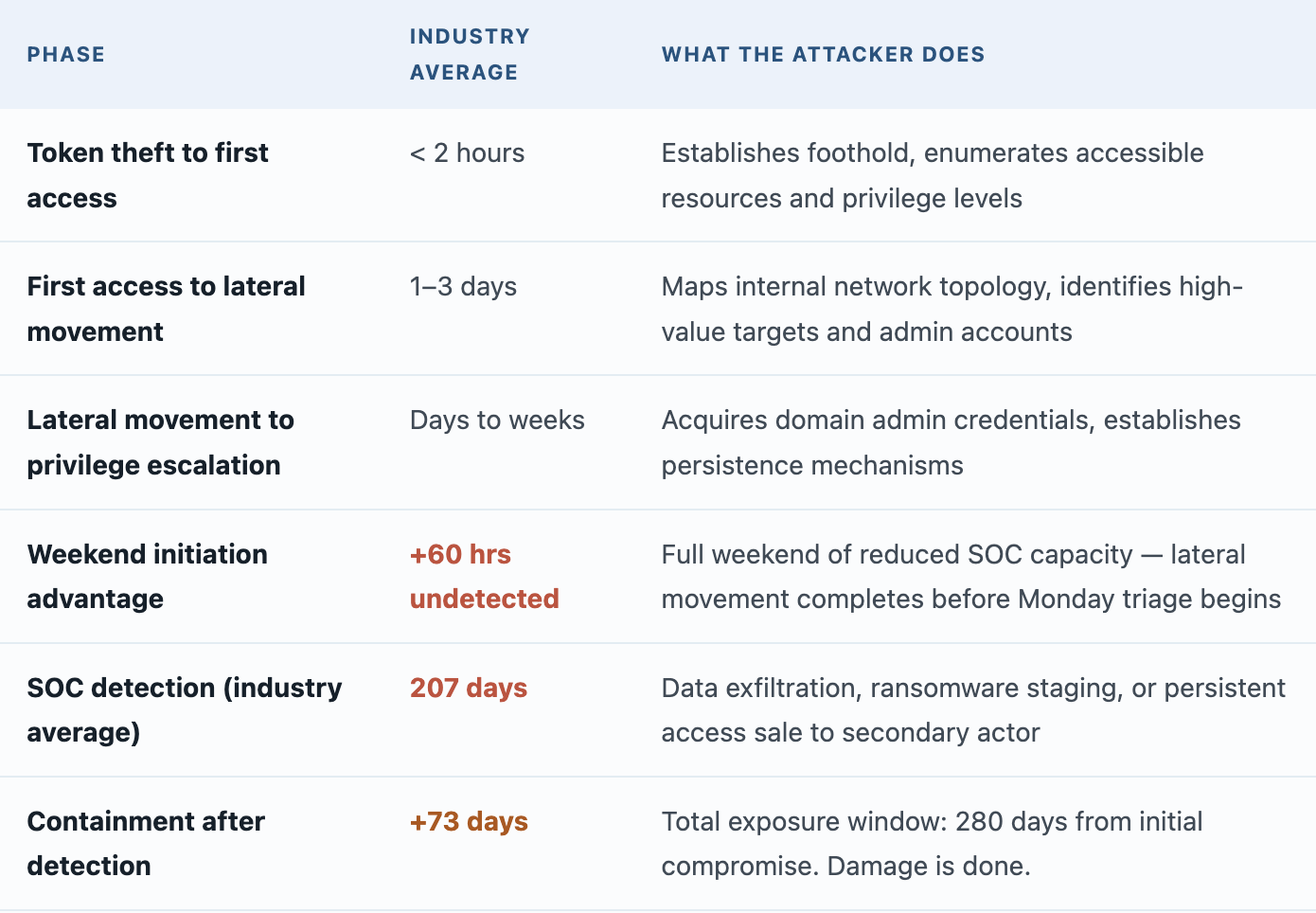
Why the weekend is the attacker's preferred window
The 50% weekend initiation figure is not a coincidence — it reflects deliberate operational timing by threat actors who understand enterprise SOC staffing models. A typical enterprise SOC runs full staffing Monday through Friday, a reduced on-call team Saturday and Sunday, and a compressed alert review cycle over the weekend that prioritises only the highest-severity automated escalations.
A stolen session token acquired at 16:30 on a Friday benefits from the following: no analyst reviews the behavioural baseline deviation until Monday; no impossible-travel alert is escalated through the weekend unless it meets a very high severity threshold; lateral movement that generates moderate-severity alerts on a Wednesday triggers an immediate analyst response, but the same alert on a Saturday sits in the queue. The attacker has mapped this. The attack is timed to it.
This cannot be solved by adding more analysts to the weekend rota alone — the economics don't work and the alert volume doesn't improve. The correct response is to make the session itself expire or become worthless before the weekend window closes.
Three architectural controls that close the session gap
1. Continuous access evaluation (CAE)
Move from static session tokens to real-time policy enforcement. CAE allows your identity provider to revoke a session mid-flight — the moment a risk signal fires (impossible travel, device compliance change, user account modification) — rather than waiting for the token to expire. Microsoft Entra ID and Okta both support CAE natively; most organisations have not enabled it. Enabling CAE reduces the window between session theft and forced re-authentication from hours to seconds — including at 02:00 on a Saturday when no analyst is watching. The session revocation happens automatically, without human intervention, regardless of SOC staffing levels. This is the single highest-impact configuration change available for most enterprise environments.
2. Short-lived token lifetimes with step-up authentication
Reduce access token lifetimes for sensitive resources to 1 hour or less. When the token expires, step-up authentication — requiring the hardware key again — gates re-entry. A stolen token acquired on Friday afternoon is dead before the attacker completes the lateral movement phase. The weekend advantage disappears because the token lifetime doesn't span the weekend. For critical systems and privileged access, token lifetimes of 15–30 minutes are operationally viable with hardware key authentication — the re-authentication takes under 3 seconds with a FIDO2 key and is significantly less disruptive than a breach notification in Q1.
3. Device-bound session tokens
Bind session tokens to the hardware credential that generated them. A token issued to a FIDO2 authenticator cannot be replayed from a different device — the cryptographic proof required to use it is physically bound to the key. This directly closes the cookie theft and AiTM replay attack vectors at the architectural level. A stolen cookie from a browser that was authenticated with a FIDO2 key is worthless without the physical key. This reduces your SOC's detection burden by eliminating the attack category entirely rather than trying to detect it in real time. Device-bound tokens are supported via the FIDO2 PRF (Pseudo-Random Function) extension and Proof of Possession (PoP) token binding, available in current Microsoft Entra ID and Google Workspace implementations.
Implementation priority and sequencing
If you implement only one thing from this volume, enable CAE. It is the highest-impact, lowest-effort control available for most organisations already running Microsoft Entra ID or Okta. It does not require changes to end-user workflows, hardware deployment, or application configuration. It requires enabling a feature in your identity provider settings and defining the risk signals that trigger revocation. For most environments this is a configuration change measurable in hours, not a project measurable in quarters.
Short-lived token lifetimes are the second priority — start with privileged accounts and sensitive resource access, then extend to the broader workforce. The step-up authentication requirement makes this viable operationally; without hardware keys, short token lifetimes generate significant user friction. With hardware keys, re-authentication is fast enough that users rarely notice the token refresh cycle.
Device-bound tokens are the architectural endpoint — the control that makes session theft structurally impossible rather than merely more detectable. This requires hardware token deployment at scale, which is the medium-term roadmap for most organisations moving through this series.
What this means for your SOC
None of these controls replace your SOC — they change what your SOC needs to detect. When sessions are short-lived and device-bound, the attack surface for session hijacking shrinks dramatically. The SOC shifts from trying to detect a stolen session in 207 days of behavioural noise to detecting the failure of a step-up authentication attempt — a signal that is categorical, immediate, and actionable regardless of when it fires. A failed step-up authentication on a Saturday at 02:00 generates an alert that your on-call team can act on in minutes, not months.
The goal is not to make your SOC faster at detecting session theft. The goal is to make session theft yield so little value — because the token is bound, short-lived, and subject to real-time revocation — that the attacker's operational calculus changes. A stolen session that expires in an hour, bound to a physical device they don't have, and subject to immediate revocation if they attempt impossible travel is not worth stealing. The attack moves elsewhere. Your 207-day detection window becomes irrelevant because there is nothing inside it worth finding.
